Same face, different score: why AI face ratings jump around, and 5 photo tips for a fairer result
If you've ever asked ChatGPT or Gemini to "rate my face", you've probably seen this happen: the same photo gets a 6 today and a 7.5 tomorrow, and a different selfie drops you to a 5.
That isn't entirely the AI's fault. While building an AI face analysis site, PSL Rating, I tested a lot of photos and found that the gap between two photos of the same person is often bigger than the gap between two different people. What moves the score is often not your face but the photo.
These are the five factors that made the biggest difference in my testing.
1. Keep the camera at eye level
This is the most common problem, and the one with the biggest effect. Shooting from below makes the chin and neck look wider, shows more of the nostrils and enlarges the lower half of the face. Shooting from above makes the forehead bigger and the chin shorter.
When AI judges face shape, jawline and facial thirds, it works from the positions of features in the photo. Tilt the angle and those proportions get calculated all over again, so every number changes. Hold the phone at roughly eye height, with the lens pointing straight at your face.
2. Don't hold it too close: straighten your arm
Most front cameras use a wide-angle lens, and the closer it is to your face, the more it distorts: the nose looks bigger, the sides of the face get "pushed" back, and the whole face looks narrower and more convex. Straighten your arm to about 30–40 cm (12–16 inches), or ask a friend to take the photo with the rear camera.
3. Face a window, avoid overhead lights
Ceiling lights cast shadows under the eyes and nose, making the eyes look deeper set, dark circles heavier and skin rougher. AI treats those shadows as real features. Ideally, stand facing a window during the day so soft natural light falls evenly on your face. Don't stand with the light behind you, and definitely don't use beauty filters.
4. Keep your head straight and your expression relaxed
A slight head tilt or a dipped chin is hard to notice, but it throws off fine measurements like canthal tilt and symmetry. A big grin also changes the shape of your cheeks and eyes. Tuck your chin slightly, keep your head level and relax your face; lips closed or a light smile both work.
5. Move your hair back and show your whole face
If bangs cover your forehead or hair hides the sides of your face, AI can't judge face shape or facial thirds accurately; it has to guess. Push your hair behind your ears so your forehead and jawline are visible. If you don't wear glasses every day, take them off too.
For a fuller checklist, see this guide: how to take a photo for a face rating.
Why I think seeing the evidence matters
The biggest problem with asking a chatbot to rate your looks isn't whether the number is high or low. It's that you don't know where the number came from, so you can't tell whether to trust it.
So I built two things into PSL Rating:
- Check the photo first, then rate. After you upload, the site first checks whether the photo itself has problems, such as the camera too low, the lighting too dark or the head tilted. If the photo isn't good enough, it tells you to retake it and gives three specific fixes, instead of forcing out an unfair score.
- Draw the measurement lines on your photo. Facial thirds, eye spacing, canthal tilt and similar values are drawn as lines on your face, so you can check for yourself whether they look right, instead of getting a black-box number.
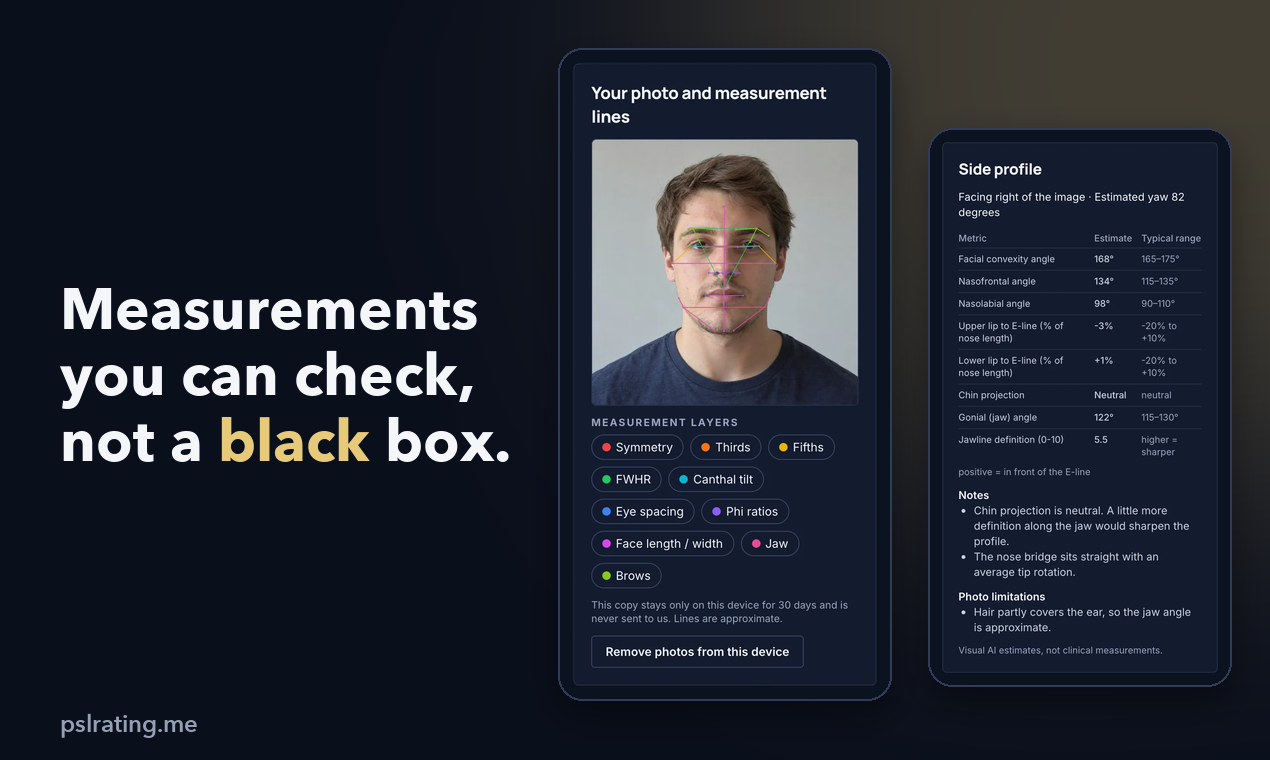
Ratings use the PSL scale (a 0–8 looks scale common on online forums), converted to the more familiar 1–10 score and a rough percentile. If PSL is new to you, here's how the PSL scale converts to a 1–10 rating.
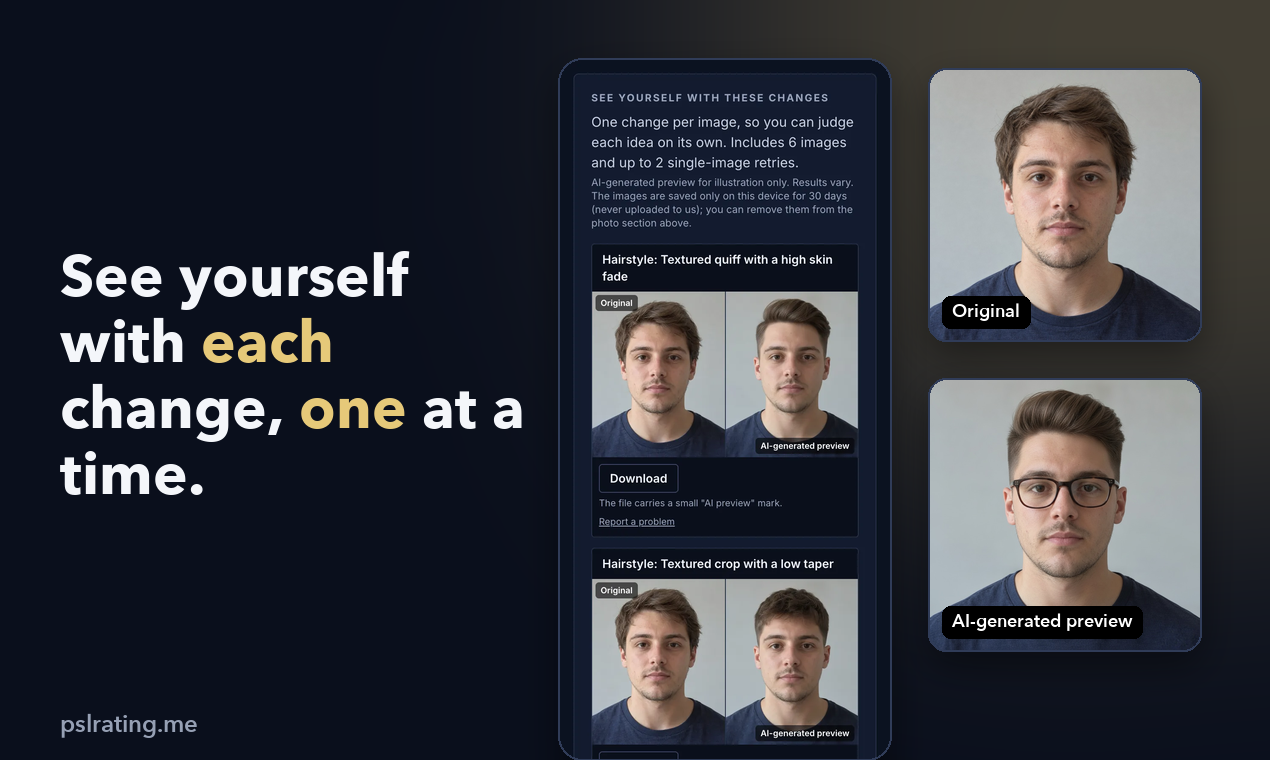
You get one free rating after signing up. If you want a deeper analysis, the full report adds region-by-region feedback, hairstyle and glasses suggestions for your face shape, and AI previews of you with a new hairstyle. You can see what it looks like in the sample report.
A final word
A face rating is just a reference: useful for understanding yourself and finding things you can improve, but not something to take too seriously. A score can't measure a person's worth, and it isn't worth losing sleep over. Very often a different angle, different light or a different haircut already makes a visible difference.
And even if you really aren't as good-looking as someone else, it's still your face and nobody else's. It's proof that you exist in this world.
If you try the tips above, come back and tell me whether your score changed.

评论
发表评论